
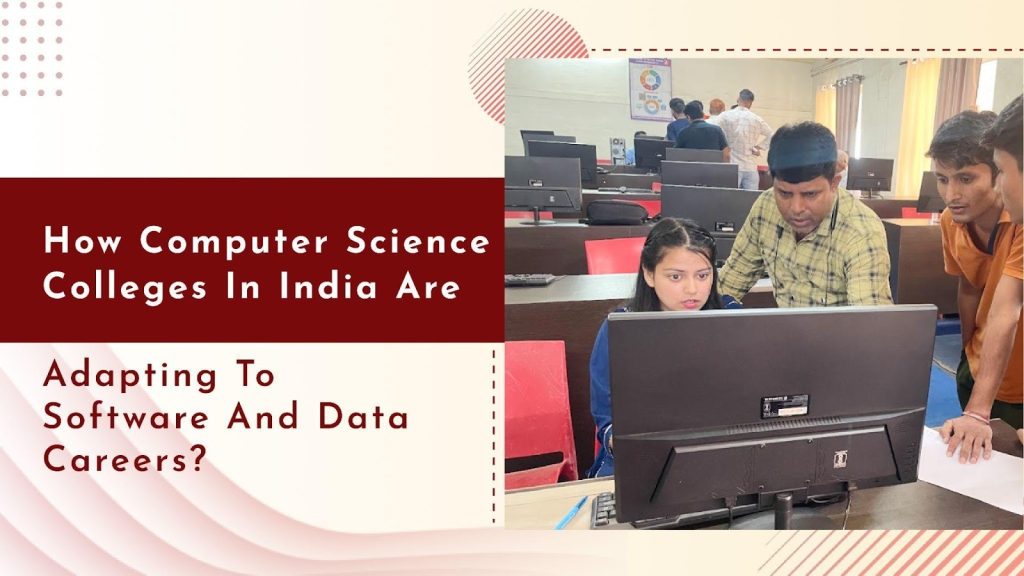
Computer Science and Engineering has evolved far beyond its traditional image of programming fundamentals and hardware theory. Today, CSE colleges in India are reshaping their academic models to align with software-driven industries, data-centric decision-making, and rapidly emerging technologies.
The digital economy in India is growing at a rate that has never been seen before. National estimates of the workforce in the technological area suggests that the nation has an output of above 1.5 million graduates in the engineering field annually with computer science being the most demanded field. However, industry feedback consistently highlights a gap between academic learning and real-world technical requirements.
To address this, modern CSE programs are increasingly focused on software development, data science, and applied technologies. This shift is not incidental. It is indicative of the evolution of the technology professions, where flexibility, critical thinking and subject area knowledge are valued equally to coding skills.
Evolution of Computer Science Careers
Computer science careers have been evolving radically in the past twenty years. Previous jobs were mainly limited to system programming, database management and IT services.
Technology experts today operate in disciplines including finance, healthcare, logistics, entertainment and governance.
This has evolved owing to several trends:
- Expansion of online platforms and web-based applications.
- Emergence of information-based businesses.
- Automation of traditional processes
- Adaptation of artificial intelligence in industries.
Economic statistics reveal that more than 65 percent of technological jobs in India are currently demanding more than entry-level programming skills (software and data skills). As a result, CSE colleges in India are updating curricula to reflect multidisciplinary and application-focused learning.
Role of Software Development in Modern CSE
Software development forms the backbone of contemporary computer science education. It is no longer confined to studying one programming language but entails the knowledge of systems, structures and scalable system architectures.
Core Software Skills Emphasised
Modern software engineering colleges focus on developing:
- Object-oriented programming concepts.
- Web and application development
- Quality assurance and software testing.
- Version control and concurrent engineering.
Students are also taught to create real applications as opposed to simply writing isolated code fragments. This will develop better problem-solving skills and equip graduates with the professional software environment.
Full Stack Development Exposure
Many computing programs now introduce full stack development, covering both front-end and back-end technologies. This assists the students in learning the interaction of the user interfaces, databases, and servers in an application.
Industry studies show that graduates with full stack exposure have higher employability across startups and product-based companies, as they can adapt to diverse development roles.
Importance of Data and Analytics
Information has taken a center stage in decision making in almost every sector. As businesses increasingly rely on analytics to gain insights, the demand for professionals skilled in data handling continues to rise.
Integration of Data Science Courses
Many CSE colleges in india now incorporate data science courses into core or elective curricula. These courses introduce students to:
- Data processing and visualisation
- Statistical analysis
- Predictive modelling
- Data-driven problem-solving
Students are taught to analyze large amounts of data instead of merely storing or accessing information.
Business and Industry Relevance
Reports suggest that data-related roles are among the fastest-growing technology careers in India, with demand increasing by over 30 percent in recent years. Graduates with exposure in data analytics have a higher chance of getting jobs in the field of finance, consulting, healthcare analytics, and e-commerce.
By embedding data science into computing programs, colleges ensure students graduate with industry-relevant analytical skills.
Emerging Technologies in CSE Curriculum
Other than software and data, computer science education has a variety of emerging technologies associated with industry innovation. Top CSE colleges in India extend precise attention to incorporating these technologies in CSE curriculum.
Artificial Intelligence Integration
AI integration in computing programs allows students to understand how intelligent systems are built and deployed. Topics often covered in CSE programs include:
- Principles of machine learning.
- Neural networks
- Natural language processing
While not all students specialise in AI, basic exposure enhances problem-solving approaches and technical adaptability.
Cloud Computing and Distributed Systems
Cloud computing has transformed how software is developed and deployed. The contemporary curricula expose students to:
- Cloud service models
- Large scale application design.
- Container technologies and virtualisation.
Industry surveys indicate that cloud-related skills are among the top five technical competencies sought by technology employers.
Cybersecurity Awareness
With the rise in digital transactions and data sharing, cybersecurity has become a critical component of computing education. Students learn:
- Network security basics
- Ethical hacking concepts
- Risk evaluation and risk reduction.
This knowledge is increasingly valuable as cybersecurity roles expand across industries.
Career Paths After Modern CSE Programs
Computer science education has undergone transformation to expand career opportunities for graduates.
Traditional and Software-Oriented Roles
Graduates can pursue roles such as:
- Software developer
- Application engineer
- Systems analyst
- Quality assurance engineer
Such positions continue to be pivotal to organisations that are technology-driven.
Data and Analytics Careers
Students have an opportunity to consider career paths that include:
- Data analyst
- Business intelligence executive.
- Junior data scientist
Data roles have excellent growth opportunities and interindustry movement.
Emerging Technology Roles
Exposure to new technologies opens pathways to:
- Cloud solutions engineer
- Cybersecurity analyst
- AI application support jobs.
Career outcome studies show that graduates from computing programs with technology-focused curricula report higher job satisfaction and faster career progression.
Academic Shift Toward Practical Learning
One of the most noticeable changes in modern computing programs is the emphasis on applied learning.
Project-Based Assessments
Instead of relying solely on written exams, many computing programs now assess students through:
- Capstone projects
- Team-based development assignments
- Industry-simulated problem statements
This methodology is reflective of the real working situation and enhances employability.
Internship and Industry Exposure
Increasingly, internships are integrated into the academic institution. Students gain:
- On-the-job industry experience.
- Exposure to professional workflows
- Networking opportunities
Students who have undergone internship are said to receive a salary 20 to 25 percent above the salaries of those who have not been exposed to a hands-on setting.
What Students Should Look for in Curriculum?
Curriculum design and delivery is an important consideration when selecting the appropriate computer science program.
Curriculum Relevance
Students should review whether the curriculum includes:
- New software development tools.
- Data analytics components
- Introduction to new technology.
Curriculum that is not dynamic can be restrictive to career flexibility.
Balance Between Theory and Practice
Good programs have a balance between:
- Computer science fundamentals
- Hands-on laboratory and project work
This balance ensures conceptual clarity alongside technical competence.
Faculty and Industry Interaction
Faculty expertise and industry engagement play a crucial role in effective learning. Programs that encourage guest lectures, workshops, and collaborative projects often provide better exposure.
Student Readiness for Future Technology Careers
Contemporary computer science education does not only focus on students being able to enter the job market on the first job, but professional development over time. The careers in technology change at a high rate and adaptability is one of the major success factors.
Students trained in software, data, and emerging technologies develop:
- Strong analytical thinking
- Problem-solving mindset
- Constant ability to learn.
These qualities enable graduates to reskill and cross-function according to the industry changes.
Conclusion
The focus on software development, data science, and emerging technologies reflects the changing landscape of technology careers. CSE colleges in India are adapting their academic frameworks to align with industry expectations, global digital trends, and multidisciplinary applications.
By integrating software engineering, data analytics, cloud computing, cybersecurity, and AI concepts, modern computing programs aim to produce graduates who are industry-ready and future-focused. This change is advantageous to the students as career opportunities are increased, and professional relevance is improved.
As a future computer science student, it is important to consider the level of curriculum, real-world exposure, and technological focus. A properly designed CSE program may be a powerful source of various and dynamic careers in the worldwide technological ecosystem.
